Embedding
In order to use \(N\)-maps to represent meshes, we need to at least associate coordinates to topological vertices (i.e. \(0\)-cells). The function that associates arbitrary data (referred to as attributes) to \(i\)-cell is called the embedding function; It relates to the mathematical notion of embedding and the existence of an injective, structure-preserving application between two spaces.
Definition: Embedding
An embedding of map \(M\) into \(E\) is an application \(f\) from the set of cells of \(M\) onto \(E\) which preserve the structure of \(M\), i.e., each \(i\)-cell of \(M\) is associated with an \(i\)-dimensional part of \(E\) so that incident cells of \(M\) are associated to incident parts of \(E\).
This is a very general definition which leaves a lot of room for implementation choices. We designed our system with robustness in mind, as we found issues within attribute handling in existing implementations (a lack of formalization surrounding attribute behavior, mostly).
Our implementation supports arbitrary attribute binding, provided that they are uniquely typed and satisfy the trait constraints required by the attribute manager.
Implementation
Because embedded data is defined per-application or per-needs, our combinatorial map implementation uses a generic system to handle this. We do not store cell identifiers in collection, and instead compute identifiers as needed for data access.
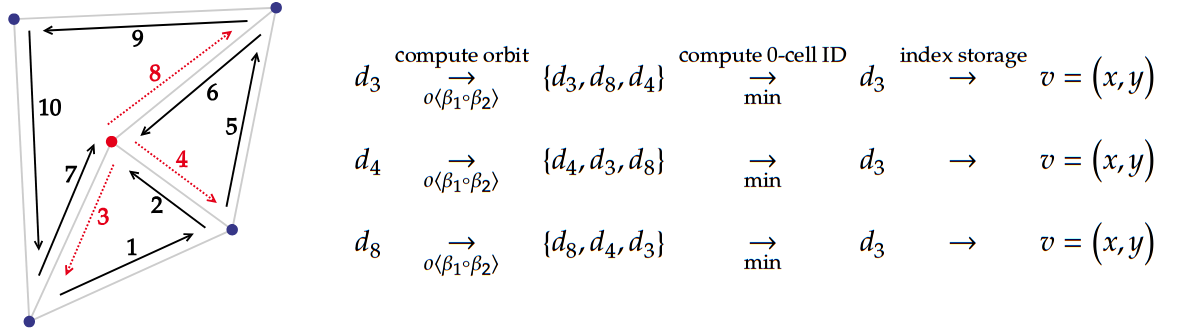
Identifiers are used to index specific attribute storages, which are distinguished using attribute type signatures. This notably implies that all attributes must be uniquely typed. For more information, consult the API documentation of the following items:
AttributeBindtrait,AttributeUpdatetrait,AttributeStoragetrait,UnknownAttributeStoragetrait,AttrStorageManagerstruct (private, go to source code or use--document-private-itemsoption).
All are defined in the honeycomb_core::attributes module.