Combinatorial maps
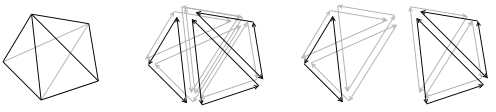
Combinatorial maps are combinatorial, graph-like, data structures which can be seen as the formalization of half-edges to higher dimensions. They can be used in dimension two and three for mesh representation, including both surface and volume 3D meshing.
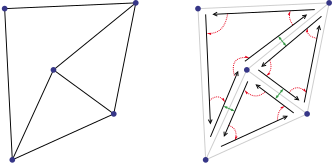
Roughly speaking, a map is simply a set of abstract elements, called darts, augmented with functions defined on this set of darts, which describe topological relations between them. This section presents the notions useful to understand maps, as they are the mai structure offered by the library.
All of the definitions we present in this section are based on G. Damiand and P. Lienhardt Combinatorial Maps: Efficient Data Structures for Computer Graphics and Image Processing; The reader may refer to this book for more details.