Cell representation
Orbits
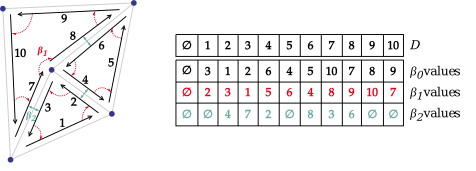
In our \(2\)-map example, applying \(\beta_1\) recursively to \(d_1\) makes us cycle through darts \(d_1\), \(d_2\), \(d_3\), that belong to different edges. Applying \(\beta_2\) to \(d_6\) makes us cycle between \(d_6\) and \(d_8\), both belonging to different faces. This set of darts accessible from a starting dart via a given \(\beta_i\) function is called orbit.
Definition: Orbit
We call orbit of \(d\) by \( \lbrace f_1, f_2, …, f_k \rbrace \) and denote \( \langle f_1, f_2, …, f_k \rangle (d)\) the set of darts retrievable from \(d\) using any composition of \(f_1, f_2, …, f_k\), including recursions. In other words, \( \langle f_1, f_2, …, f_k \rangle (d)\) refers to the set of darts connected to \(d\), via the \(f_1, f_2, …, f_k\) functions.
The set is obtained by doing a Breadth First Search algorithm from the starting dart \(d\), where each connected node is the image of the current dart via one function \(f \in \lbrace f_1, f_2, …, f_k \rbrace\). The order in which nodes are explored is determined by the order of the function set.
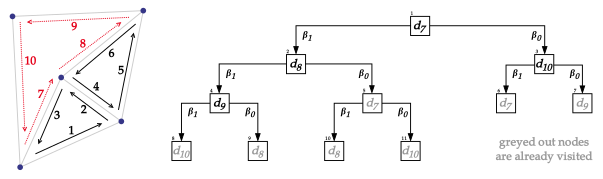
For example, the orbit \(\langle \beta _2 \rangle (d)\) refers to the subset of unique darts accessible from dart \(d\) using any composition of \(\beta_2\), including recursive ones. The orbit \(\langle \beta_1, \beta_0 \rangle (d_7)\) refers to darts accessible from dart \(d_7\) using any composition of \(\beta_1\) and \(\beta_0\). The computation process is detailed below.
\(i\)-cells
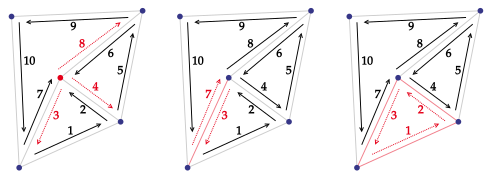
Specific values of orbits can be used to define the cells commonly used in meshing algorithms. These specific values are referred to as \(i\)-cells. For example the subset of dart defined by \( \langle \beta_1 \rangle (d)\) corresponds to darts of a face, i.e., a \(2\)-cell. The subset of dart defined by orbit \( \langle \beta_2 \rangle (d)\) corresponds to darts of an edge, i.e., a \(1\)-cell.
Definition: \(0\)-cell
Let \(d \in D\). The \(0\)-dimensional cell associated to dart \(d\) is \( \langle { \beta_j \circ \beta_k, 1 \le j < k \le N } \rangle (d)\).
Definition: \(i\)-cell, \(i \ne 0\)
Let \(d \in D\). The \(i\)-dimensional cell associated to dart \(d\) is \(\langle \beta _1, …, \beta _{i-1}, \beta _{i+1}, …, \beta _N \rangle (d)\).
Our interest lies in mesh representation, so we use these definitions applied to dimension 2 and 3.
| i | Geometry | 2-map | 3-map |
|---|---|---|---|
| 0 | Vertex | \( \langle \beta_1 \circ \beta_2 \rangle (d)\) | \(\langle \beta_1 \circ \beta_2, \beta_1 \circ \beta_3, \beta_2 \circ \beta_3 \rangle (d)\) |
| 1 | Edge | \(\langle \beta_2 \rangle (d)\) | \(\langle \beta_2, \beta_3 \rangle (d)\) |
| 2 | Face | \(\langle \beta_1 \rangle (d)\) | \(\langle \beta_1, \beta_3 \rangle (d)\) |
| 3 | Volume | - | \(\langle \beta_1, \beta_2 \rangle (d)\) |