Applications
The applications crate contains multiple binaries which serve as benchmarks and examples for the
library. The following targets are defined:
| Algorithm | Target binary | Dimension |
|---|---|---|
| Delaunay triangulation | incremental-delaunay | 3D |
| Edge cut | cut-edges | 2D |
| Overlay grid (intersection-based) | grisubal | 2D |
| Overlay grid (refinement-based) | overlay-grid | 2D |
| Parameterized grid generation | generate-grid | 2D and 3D |
| Polygon triangulation | triangulate | 2D |
| Remeshing pipeline proxy-application | remesh | 2D |
| Vertex smooth | shift-vertices | 2D |
Most algorithms work on 2D meshes because the structure was implemented first in 2D. Nonetheless, the 3D structure is just as polished, and the 3D Delaunay triangulation was the most consequential algorithm in our optimization process as it highlighted issues that did not appear in 2D.
Each binary has a documented CLI, which can be printed using the --help option. Outputs can be
serialized, and, if the render feature is enabled, the output mesh will be displayed at the end
of the execution.
Delaunay triangulation
This is a 3D incremental Delaunay triangulation implementation. It roughly follows the algorithm presented in One machine, one minute, three billion tetrahedra, Marot et al, 2019. We do not implement boundary recovery, and focus on the benchmarking aspect by sampling point in a box-shaped domain and inserting them into a first basic triangulation.
Edge cut
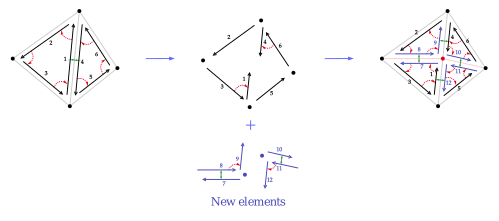
This algorithm apply a basic edge cut operation to all edges of the mesh until a target length is reached.
Overlay grid
Intersection-based
This mesh generation algorithms uses intersection with an overlaid grid to create a triangular mesh of a geometry passed as input.
Refinement-based
This mesh generation algorithms uses incremental refinement of an octree and its dualization to create an hexahedral mesh of the input geometry.
Parameterized grid generation
This is a grid generation algorithm for our structure, i.e., mesh instantiation with pre-definite values representing a grid.
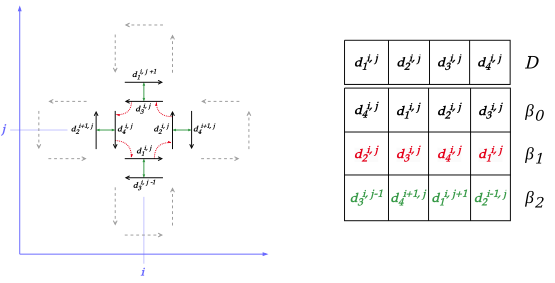
Elements of the grid can be indexed in a systematic manner. Thanks to this, we implemented an
efficient parallel version of this algorithm, as well as a GPU version which outperforms the
parallel CPU one. We use the cudarc crate to offload
the value generation to the GPU.
Polygon triangulation
This algorithm allows triangulation of simple 2D polygon using one of two methods:
ear-clipping or
fanning. The binary triangulates the entire
mesh input, while honeycomb-kernel provides the routine call used to triangulate a single cell.
Remeshing pipeline proxy-application
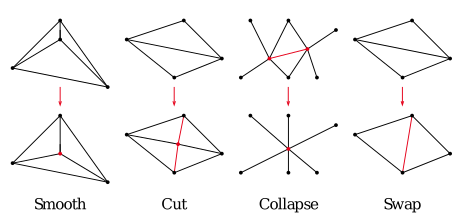
This algorithm is a proxy-application for very common remeshing workflow found in triangle or tetrahedron meshing. Multiple meshing kernels are applied in a loop until a certain predicate is satisfied, or for a given number of rounds.
Vertex smooth
We implement two parameterized smoothing algorithm: Laplace smoothing and Taubin smoothing. A current work in progress includes a GPU-based Jacobi smoother using a Rust-Kokkos interoperability library.